
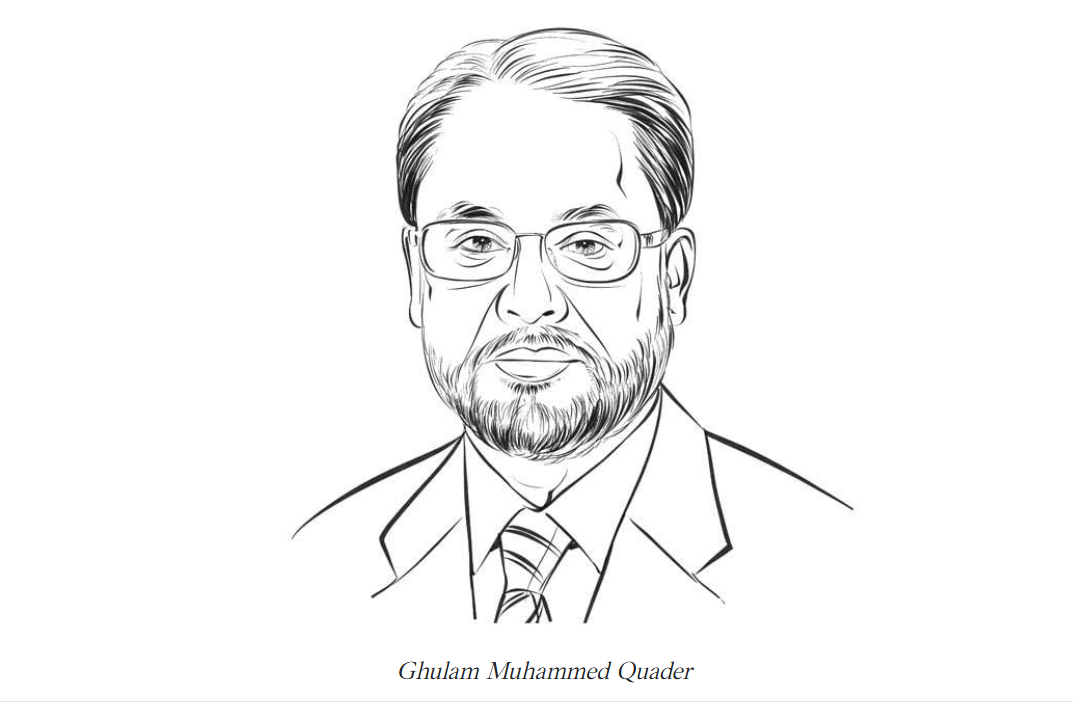
Ghulam Muhammed Quader | Khaborer Kagoj
Published at : 06 March 2026, 10:12 pm
Jatiya Party (JP) is satisfied with the results of the 13th National Parliamentary election. We conveyed our feelings by congratulating the ruling party Bangladesh Nationalist Party (BNP), for forming the government after the election.
If the election had not been held, or in case the currently ruling party did not get the absolute majority in Parliament, there was a possibility that the interim government might have remained in power indefinitely.
The way the interim government was running the country, we were afraid there could have been famine and civil war. Bangladesh would have emerged as a failed state under the circumstances and ultimately with the consequence of turning itself into a territory controlled by Islamist Militant groups.
Now the obvious question comes, whether that means we recognize this election to be a good one.
According to our assessment, this election was even worse than the imperfect elections of 2018 and 2024.
Based on various information collected from the field, average voter turnout, the total votes shown, irregularities during counting, signs of manipulation in result sheets, the way results were declared, the big difference between total number of votes and the votes counted in referendum (which was initially almost half compared to total votes), the apparent fraudulent way that anomaly was tried to be minimized creating more suspicion etc., – considering past experiences in similar circumstances – we conclude that the election was conducted with the objective of achieving a predetermined result.
Naturally, all possible measures were taken, and best efforts were provided so that the election looked fair and competitive.
One interesting exception that may be noted here. Unlike what happened in the past, the beneficiary or the winning party was not directly involved in the irregularities. An election was held under the interim government. BNP did not have such wide-scale control over the administrative setup to orchestrate such a large-scale manipulative operation.
Under the circumstances, it is difficult to gather documentary evidence. Given the current situation, how effective the concerned authorities or judiciary would be or could be is a big question. Moreover, JP is not against the outcome. It may be said, legality of the election will be accepted, ultimately. We believe it is difficult to suppress the truth. Maybe someday in the future, facts will come out that could tally with what we say now.
Moreover, this election has some major deficiencies, due to which it cannot be termed as a good election. By definition good election must be ‘free and fair’.
‘Free’ means freely participated in by all voters and all political parties. Free includes ‘inclusiveness’. In this election, Bangladesh Awami League (BAL), one of the two major political parties, the oldest and with a very colorful past, along with some other parties, have been denied participation by an administrative order.
The term ‘Fair’ signifies fairness to all the participants. Implies a neutral or unbiased environment and equal opportunities for all participants and participating parties.
To start with, the Election Commission (EC), a constitutional body responsible for conducting the election who can be considered the referee of the contest, was not neutral. They organized pre-election consultation meetings with the participating parties and invited everybody. EC did meet more than once with some. But did not invite JP. Even when JP representatives wanted an appointment to discuss, it was refused.
The interim government has arranged extensive state protocol and privileges for the government-sponsored party, National Citizen Party (NCP), parties close to the interim government like Jamaat-e-Islami (JI), and their alliances, almost as if they were the government itself. Similar privileges were given to BNP and its allies. But no such facility was allowed to JP.
Three leaders from the JI alliance and one from the BNP were allowed free time on state television before elections. JP was denied a similar opportunity.
Many JP leaders and activists were falsely implicated in different criminal cases throughout the country during the interim government after the July mass uprising, and they were under threat of arrest and harassment all the time, even during elections.
Three JP candidates had to compete from inside jail. They were arrested, denied bail several times, ultimately allowed bail, but were shown to be under arrest in some other case and were not released from custody. Two of our candidates withdrew from the contest as they, especially their workers, did not want to continue under hostile circumstances from law enforcement agencies.
For nearly one and a half years before the election and even during the election period in some places, the government machinery itself or with their patronage NCP, JI and BNP party activists obstructed Jatiya Party’s meetings, rallies, and political activities. JP offices were vandalized, leaders were physically assaulted, harassed, and false cases were filed.
Starting from about a year before the election till the end of the election, the above parties, especially JI spent thousands of crores of taka to influence the election results.
Allegations against the above-mentioned parties were received from different places where voters belonging to minority communities, voters loyal to BAL, and in some places voters of JP were threatened with dire consequences if they did not vote for them.
Therefore, voters did not have the opportunity to vote in a neutral environment using their judgment freely without any bias for money or fear of retribution. The election was heavily influenced by money and muscle power.
Jatiya Party did not receive equal opportunities or a neutral environment. Instead, it faced repression, violence, and harassment.
In summary, the 13th National Parliamentary Election was not free, fair, inclusive, or conducted in a neutral environment, or not influenced by the use of money and muscle, where a level playing field for all was ensured. Therefore, it cannot be termed a good election.
*Author: Ghulam Muhammed Quader, Chairman, Jatiya Party.
LinK: https://english.khaborerkagoj.com/opinion/804668