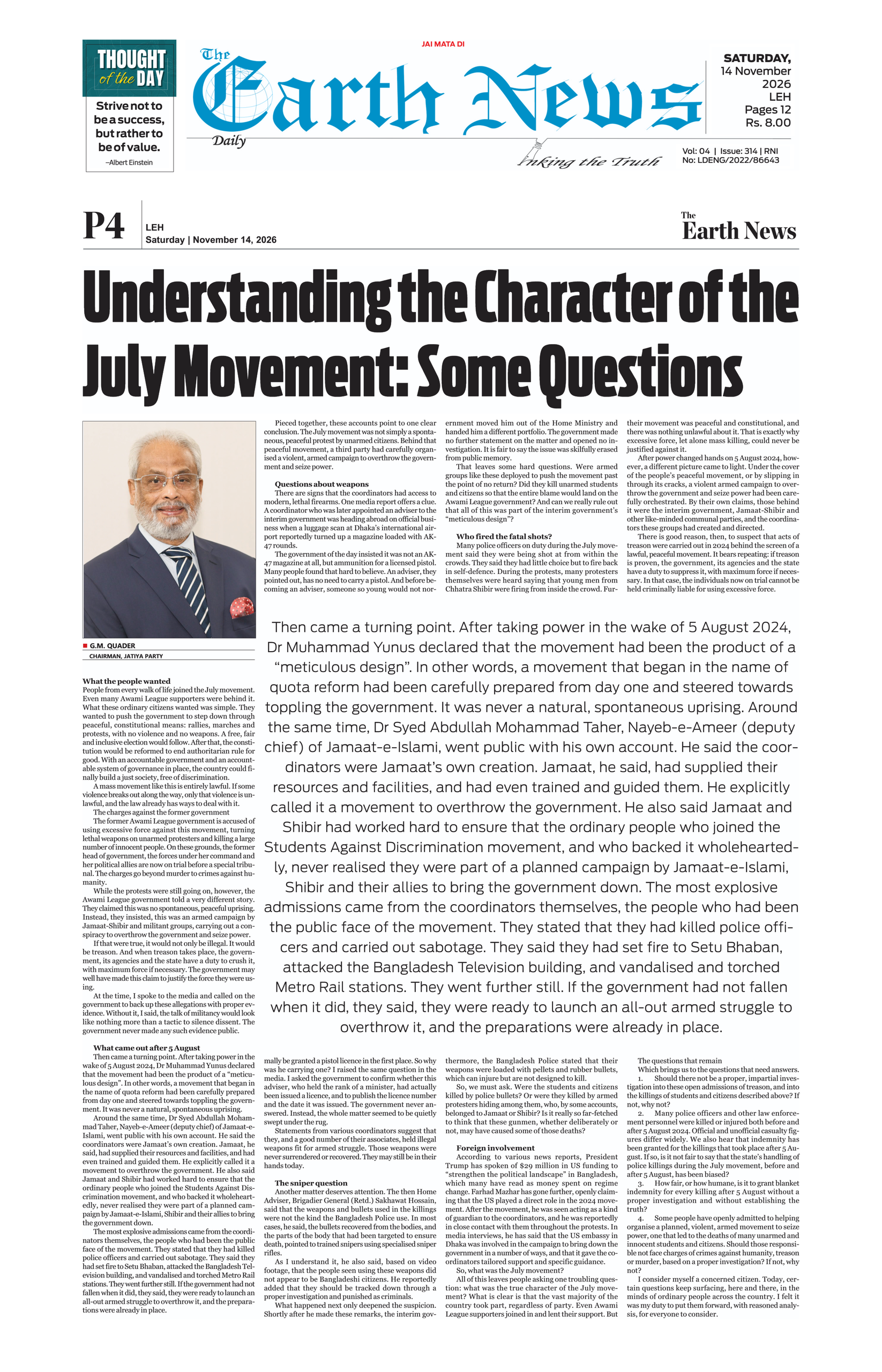

G.M. Quader | The Earth News
Understanding the Character of the July Movement: Some Questions
G.M. Quader
What the people wanted
People from every walk of life joined the July movement. Even many Awami League supporters were behind it. What these ordinary citizens wanted was simple. They wanted to push the government to step down through peaceful, constitutional means: rallies, marches and protests, with no violence and no weapons. A free, fair and inclusive election would follow. After that, the constitution would be reformed to end authoritarian rule for good. With an accountable government and an accountable system of governance in place, the country could finally build a just society, free of discrimination.
A mass movement like this is entirely lawful. If some violence breaks out along the way, only that violence is unlawful, and the law already has ways to deal with it.
The charges against the former government
The former Awami League government is accused of using excessive force against this movement, turning lethal weapons on unarmed protesters and killing a large number of innocent people. On these grounds, the former head of government, the forces under her command and her political allies are now on trial before a special tribunal. The charges go beyond murder to crimes against humanity.
While the protests were still going on, however, the Awami League government told a very different story. They claimed this was no spontaneous, peaceful uprising. Instead, they insisted, this was an armed campaign by Jamaat-Shibir and militant groups, carrying out a conspiracy to overthrow the government and seize power.
If that were true, it would not only be illegal. It would be treason. And when treason takes place, the government, its agencies and the state have a duty to crush it, with maximum force if necessary. The government may well have made this claim to justify the force they were using.
At the time, I spoke to the media and called on the government to back up these allegations with proper evidence. Without it, I said, the talk of militancy would look like nothing more than a tactic to silence dissent. The government never made any such evidence public.
What came out after 5 August
Then came a turning point. After taking power in the wake of 5 August 2024, Dr Muhammad Yunus declared that the movement had been the product of a “meticulous design”. In other words, a movement that began in the name of quota reform had been carefully prepared from day one and steered towards toppling the government. It was never a natural, spontaneous uprising.
Around the same time, Dr Syed Abdullah Mohammad Taher, Nayeb-e-Ameer (deputy chief) of Jamaat-e-Islami, went public with his own account. He said the coordinators were Jamaat’s own creation. Jamaat, he said, had supplied their resources and facilities, and had even trained and guided them. He explicitly called it a movement to overthrow the government. He also said Jamaat and Shibir had worked hard to ensure that the ordinary people who joined the Students Against Discrimination movement, and who backed it wholeheartedly, never realised they were part of a planned campaign by Jamaat-e-Islami, Shibir and their allies to bring the government down.
The most explosive admissions came from the coordinators themselves, the people who had been the public face of the movement. They stated that they had killed police officers and carried out sabotage. They said they had set fire to Setu Bhaban, attacked the Bangladesh Television building, and vandalised and torched Metro Rail stations. They went further still. If the government had not fallen when it did, they said, they were ready to launch an all-out armed struggle to overthrow it, and the preparations were already in place.
Pieced together, these accounts point to one clear conclusion. The July movement was not simply a spontaneous, peaceful protest by unarmed citizens. Behind that peaceful movement, a third party had carefully organised a violent, armed campaign to overthrow the government and seize power.
Questions about weapons
There are signs that the coordinators had access to modern, lethal firearms. One media report offers a clue. A coordinator who was later appointed an adviser to the interim government was heading abroad on official business when a luggage scan at Dhaka’s international airport reportedly turned up a magazine loaded with AK-47 rounds.
The government of the day insisted it was not an AK-47 magazine at all, but ammunition for a licensed pistol. Many people found that hard to believe. An adviser, they pointed out, has no need to carry a pistol. And before becoming an adviser, someone so young would not normally be granted a pistol licence in the first place. So why was he carrying one? I raised the same question in the media. I asked the government to confirm whether this adviser, who held the rank of a minister, had actually been issued a licence, and to publish the licence number and the date it was issued. The government never answered. Instead, the whole matter seemed to be quietly swept under the rug.
Statements from various coordinators suggest that they, and a good number of their associates, held illegal weapons fit for armed struggle. Those weapons were never surrendered or recovered. They may still be in their hands today.
The sniper question
Another matter deserves attention. The then Home Adviser, Brigadier General (Retd.) Sakhawat Hossain, said that the weapons and bullets used in the killings were not the kind the Bangladesh Police use. In most cases, he said, the bullets recovered from the bodies, and the parts of the body that had been targeted to ensure death, pointed to trained snipers using specialised sniper rifles.
As I understand it, he also said, based on video footage, that the people seen using these weapons did not appear to be Bangladeshi citizens. He reportedly added that they should be tracked down through a proper investigation and punished as criminals.
What happened next only deepened the suspicion. Shortly after he made these remarks, the interim government moved him out of the Home Ministry and handed him a different portfolio. The government made no further statement on the matter and opened no investigation. It is fair to say the issue was skilfully erased from public memory.
That leaves some hard questions. Were armed groups like these deployed to push the movement past the point of no return? Did they kill unarmed students and citizens so that the entire blame would land on the Awami League government? And can we really rule out that all of this was part of the interim government’s “meticulous design”?
Who fired the fatal shots?
Many police officers on duty during the July movement said they were being shot at from within the crowds. They said they had little choice but to fire back in self-defence. During the protests, many protesters themselves were heard saying that young men from Chhatra Shibir were firing from inside the crowd. Furthermore, the Bangladesh Police stated that their weapons were loaded with pellets and rubber bullets, which can injure but are not designed to kill.
So, we must ask. Were the students and citizens killed by police bullets? Or were they killed by armed protesters hiding among them, who, by some accounts, belonged to Jamaat or Shibir? Is it really so far-fetched to think that these gunmen, whether deliberately or not, may have caused some of those deaths?
Foreign involvement
According to various news reports, President Trump has spoken of $29 million in US funding to “strengthen the political landscape” in Bangladesh, which many have read as money spent on regime change. Farhad Mazhar has gone further, openly claiming that the US played a direct role in the 2024 movement. After the movement, he was seen acting as a kind of guardian to the coordinators, and he was reportedly in close contact with them throughout the protests. In media interviews, he has said that the US embassy in Dhaka was involved in the campaign to bring down the government in a number of ways, and that it gave the coordinators tailored support and specific guidance.
So, what was the July movement?
All of this leaves people asking one troubling question: what was the true character of the July movement? What is clear is that the vast majority of the country took part, regardless of party. Even Awami League supporters joined in and lent their support. But their movement was peaceful and constitutional, and there was nothing unlawful about it. That is exactly why excessive force, let alone mass killing, could never be justified against it.
After power changed hands on 5 August 2024, however, a different picture came to light. Under the cover of the people’s peaceful movement, or by slipping in through its cracks, a violent armed campaign to overthrow the government and seize power had been carefully orchestrated. By their own claims, those behind it were the interim government, Jamaat-Shibir and other like-minded communal parties, and the coordinators these groups had created and directed.
There is good reason, then, to suspect that acts of treason were carried out in 2024 behind the screen of a lawful, peaceful movement. It bears repeating: if treason is proven, the government, its agencies and the state have a duty to suppress it, with maximum force if necessary. In that case, the individuals now on trial cannot be held criminally liable for using excessive force.
The questions that remain
Which brings us to the questions that need answers.
- Should there not be a proper, impartial investigation into these open admissions of treason, and into the killings of students and citizens described above? If not, why not?
- Many police officers and other law enforcement personnel were killed or injured both before and after 5 August 2024. Official and unofficial casualty figures differ widely. We also hear that indemnity has been granted for the killings that took place after 5 August. If so, is it not fair to say that the state’s handling of police killings during the July movement, before and after 5 August, has been biased?
- How fair, or how humane, is it to grant blanket indemnity for every killing after 5 August without a proper investigation and without establishing the truth?
- Some people have openly admitted to helping organise a planned, violent, armed movement to seize power, one that led to the deaths of many unarmed and innocent students and citizens. Should those responsible not face charges of crimes against humanity, treason or murder, based on a proper investigation? If not, why not?
I consider myself a concerned citizen. Today, certain questions keep surfacing, here and there, in the minds of ordinary people across the country. I felt it was my duty to put them forward, with reasoned analysis, for everyone to consider.
(The Author is the Chairman Jatiya Party (JaPa) – a political outfit in Bangladesh.)